
Arugam Bay

Arugam Bay is situated on the Indian Ocean in the dry zone of Sri Lanka’s southeast coast, and a historic settlement of the ancient Batticaloa Territory (Mattakallappu Desam). The bay is located 117 kilometres (73 mi) south of Batticaloa, 320 kilometres (200 mi) due east of Colombo, and approximately 4 kilometres (2.5 mi) south of the market town of Pottuvil. The main settlement in the area, known locally as Ullae, is predominantly Muslim, however there is a significant Sri Lankan Tamil and Sinhala population to the south of the village, as well as a number of international expatriates, largely from Europe and Australia. While traditionally fishing has dominated the local economy, tourism has grown rapidly in the area in recent years. Arugam Kudah’s literal Tamil translation is “Bay of Cynodon dactylon”. Tourism in Arugam Bay is dominated by surf tourism, thanks to several quality breaks in the area, however tourists are also attracted by the local beaches, lagoons, historic temples and the nearby Kumana National Park.
KUMANA NATIONAL PARK
Kumana National Park in Sri Lanka is renowned for its avifauna, particularly its large flocks of migratory waterfowl and wading birds. The park is 391 kilometres (243 mi) southeast of Colombo on Sri Lanka's southeastern coast. Kumana is contiguous with Yala National Park.Kumana was formerly known as Yala East National Park, but changed to its present name on 5 September 2006.
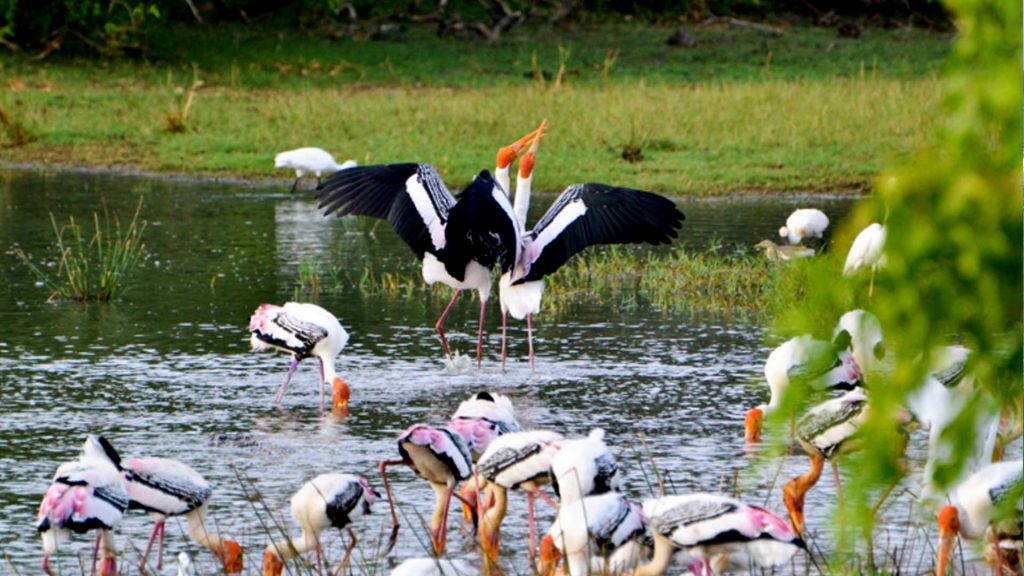
Kumana Bird Sanctuary, declared in 1938, is included within the Kumana National Park. Kumana is one of the most important bird nesting and breeding grounds in Sri Lanka. 255 species of birds have been recorded in the national park. From April to July tens of thousands of birds migrate to the Kumana swamp area. Rare species such as black-necked stork, lesser adjutant, Eurasian spoonbill, and great thick-knee are breeding inhabitants.Waders belonging to families Scolopacidae and Charadriidae are among the visitors to the area along with waterfowl. Pintail snipes migrate here flying 9,000 kilometres (5,600 mi) to 11,000 kilometres (6,800 mi) from Siberia. Asian openbill, glossy ibis, purple heron, great egret, Indian pond heron, black-crowned night heron, intermediate egret, little egret, spot-billed pelican, Indian cormorant, little cormorant, common moorhen, watercock, purple swamphen, white-breasted waterhen, pheasant-tailed jacana, black-winged stilt, lesser whistling duck and little grebe are the bird species migrate here in large flocks. Among the rare birds that migrate to the swap are the yellow-footed green pigeon, greater racket-tailed drongo, Malabar trogon, red-faced malkoha, and sirkeer malkoha. Pacific golden plover, greater sand plover, lesser sand plover, grey plover, ruddy turnstone, little ringed plover, wood sandpiper, marsh sandpiper, common redshank, common sandpiper, curlew sandpiper, little stint, common snipe, and pintail snipe are the common wading birds of the park.
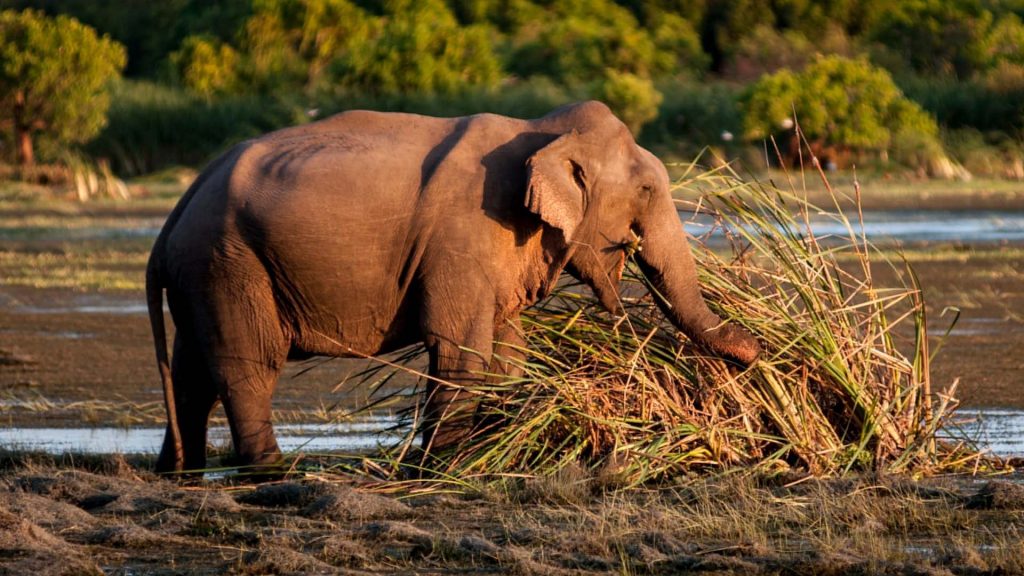
Tilapia and mullet are the commonly fished varieties in the area while Channa spp. are also caught occasionally. Mugger crocodile, Indian flap-shelled turtle and Indian black turtle are the common reptiles inhabiting the park. Mammals such as golden jackal, wild boar, Sri Lankan elephant, European otter, and fishing cat also visit the swamp to feed. The number of elephants roaming in the Kumana is estimated at 30–40.